
Introduction
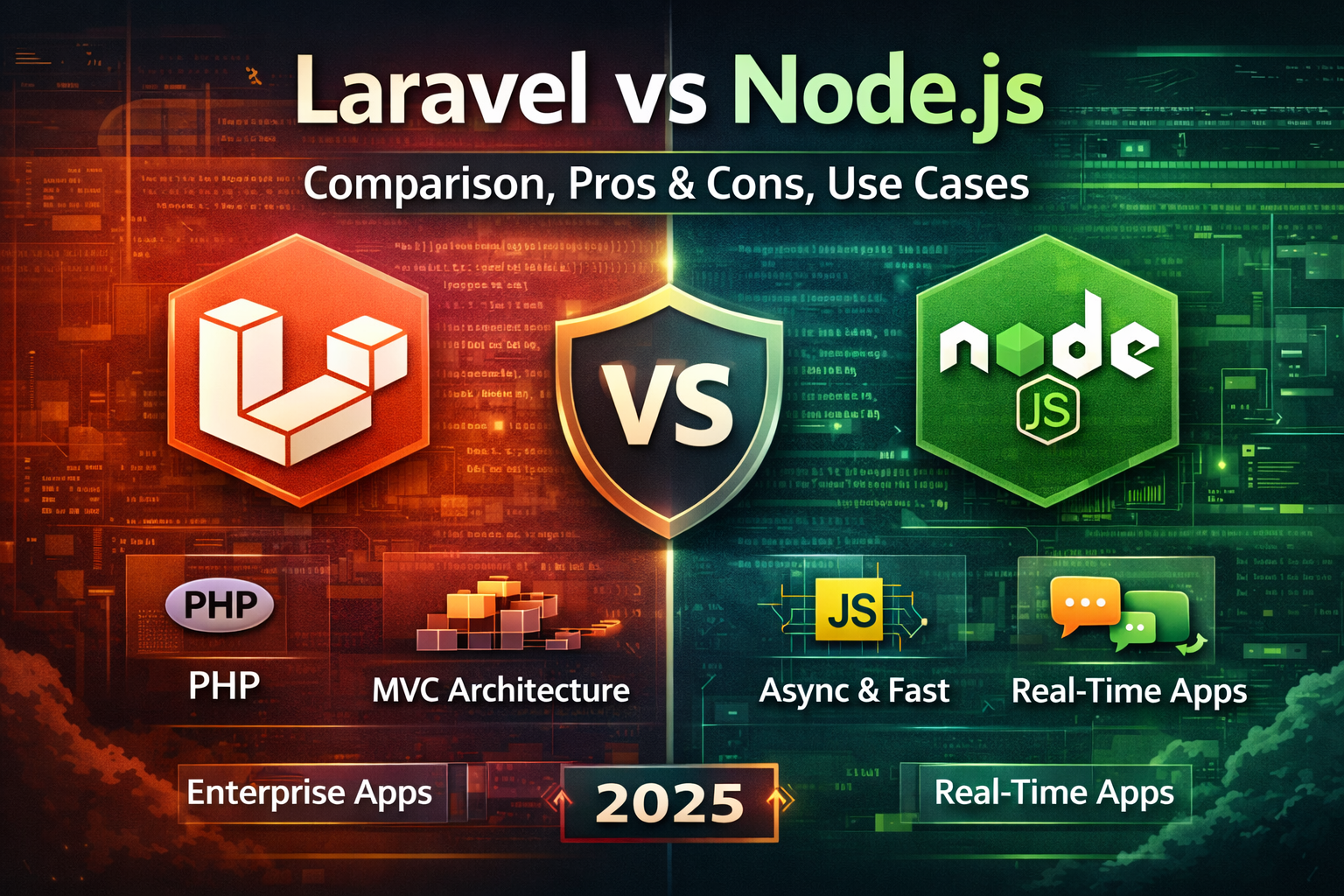
Choosing the right backend technology is one of the most critical decisions in modern web application development. Two of the most widely used backend technologies today are Laravel and Node.js. Both are powerful, scalable, and trusted by developers worldwide, yet they follow very different approaches and philosophies.
Laravel is a PHP-based full-stack framework known for its elegant syntax and rapid development capabilities, while Node.js is a JavaScript runtime designed for building high-performance, event-driven, and real-time applications. In this blog, we will compare Laravel vs Node.js in detail, covering their features, pros and cons, performance, use cases, and when to choose which technology.
What is Laravel?
Laravel is an open-source PHP framework built on the Model–View–Controller (MVC) architecture. It simplifies backend development by providing built-in tools for routing, authentication, session handling, caching, and database management. Laravel emphasizes clean code, security, and developer productivity.
Laravel is widely used for building enterprise applications, content management systems, ERP solutions, SaaS platforms, and API-driven backends.
What is Node.js?
Node.js is an open-source, cross-platform JavaScript runtime environment that allows developers to execute JavaScript code on the server side. Built on Google Chrome’s V8 engine, Node.js is designed for high-performance, asynchronous, and non-blocking applications.
Node.js is commonly used for real-time applications, REST APIs, microservices, and modern cloud-native systems.
Core Architecture Comparison
| Aspect | Laravel | Node.js |
|---|---|---|
| Language | PHP | JavaScript |
| Architecture | MVC (Synchronous) | Event-Driven, Non-Blocking |
| Execution Model | Request-based | Single-threaded with async I/O |
| Best For | Structured business applications | Real-time and high-concurrency apps |
Pros and Cons of Laravel
Advantages of Laravel
- Rapid Development: Built-in features like authentication, migrations, and Artisan CLI speed up development.
- Clean MVC Structure: Ensures maintainable, organized, and scalable code.
- High Security: Built-in protection against CSRF, XSS, and SQL injection.
- Powerful ORM: Eloquent ORM simplifies database operations.
- Strong Community & Ecosystem: Extensive documentation and packages.
Disadvantages of Laravel
- Slower performance compared to Node.js for real-time applications.
- Not ideal for handling a very large number of concurrent connections.
- PHP-based ecosystem may not suit JavaScript-only teams.
Pros and Cons of Node.js
Advantages of Node.js
- High Performance: Non-blocking I/O handles multiple requests efficiently.
- Single Language: JavaScript for both frontend and backend.
- Excellent for Real-Time Apps: Chat apps, live tracking, streaming.
- Scalable & Cloud-Friendly: Ideal for microservices and serverless.
- Massive NPM Ecosystem: Millions of reusable packages.
Disadvantages of Node.js
- Callback-heavy logic can become complex if not structured properly.
- Requires strong architectural discipline for large applications.
- Not ideal for CPU-intensive tasks.
Performance Comparison
Node.js generally outperforms Laravel in applications requiring high concurrency and real-time communication due to its asynchronous nature. Laravel performs excellently in traditional request-response cycles and complex business logic but may struggle with massive simultaneous connections.
Where to Use Laravel?
- ERP, CRM, and HRMS systems
- Business automation applications
- Content Management Systems (CMS)
- E-commerce platforms
- SaaS applications with structured workflows
Where to Use Node.js?
- Real-time chat and notification systems
- RESTful APIs for mobile and SPA applications
- Microservices architecture
- Streaming platforms
- IoT and event-driven systems
Laravel vs Node.js: Which One Should You Choose?
The choice between Laravel and Node.js depends on your project requirements, team expertise, and scalability needs.
- Choose Laravel if your project requires strong structure, rapid development, security, and complex business logic.
- Choose Node.js if your application needs real-time capabilities, high concurrency, microservices, or JavaScript-based full-stack development.
Conclusion
Both Laravel and Node.js are powerful backend technologies with their own strengths and ideal use cases. Laravel excels in enterprise-level, structured applications, while Node.js dominates real-time, scalable, and modern cloud-based systems.
Rather than viewing Laravel vs Node.js as competitors, many modern systems successfully use both together—Laravel for core business logic and Node.js for real-time services. Understanding when and where to use each technology is the key to building efficient and future-ready applications.




Discussion (0)
Leave a comment